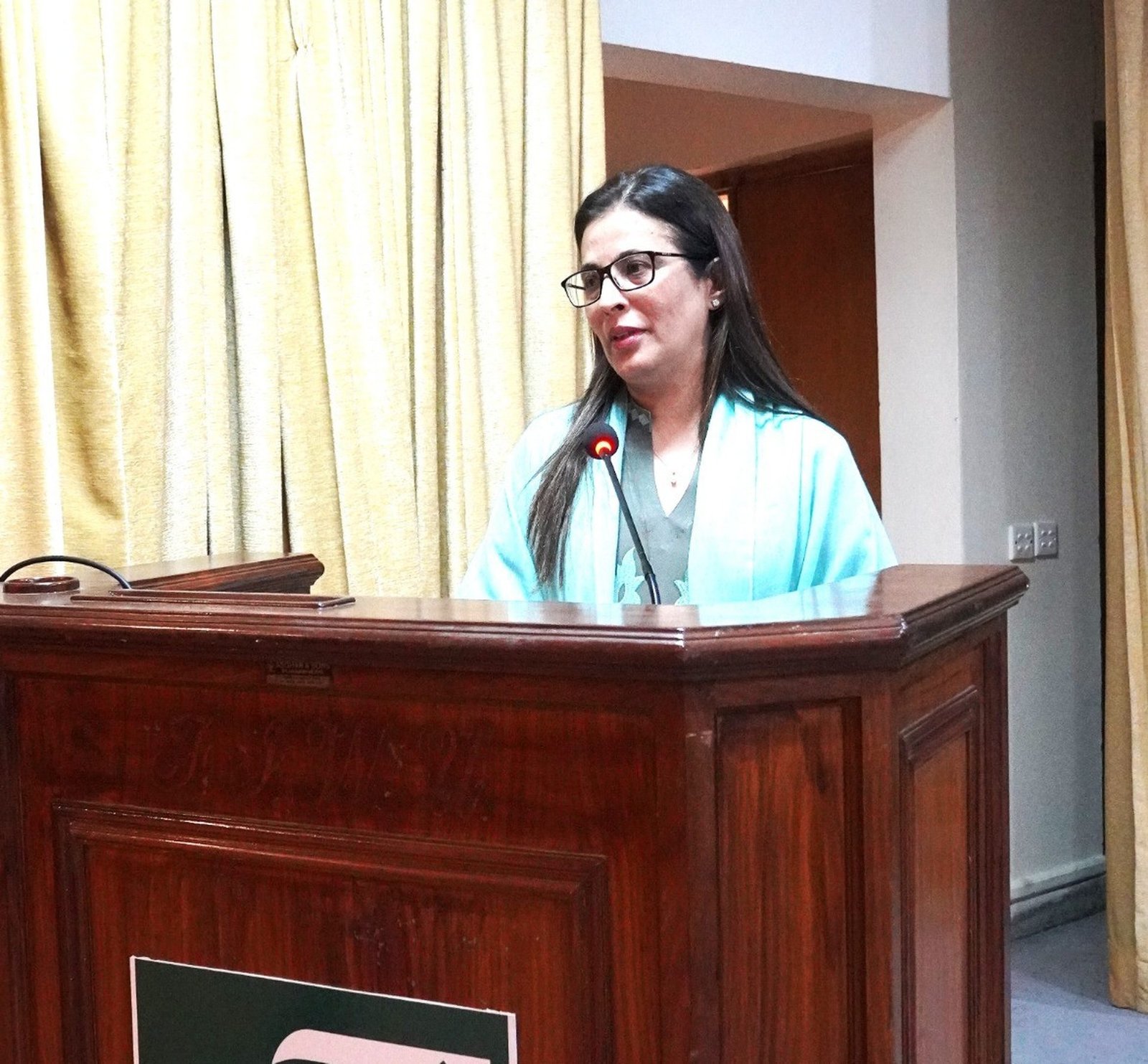
Supreme Court Judge Justice Ayesha Malik has said that Pakistan possesses strong statutory laws to protect women, but turning legal rights into real protection requires legal literacy, effective enforcement, and a gender perspective that challenges entrenched patriarchal mindsets.
Justice Malik was delivering the keynote address at a seminar titled “Human Rights and Legal Awareness”, organised at Fatima Jinnah Women University in Rawalpindi under the 16 Days of Activism Against Gender-Based Violence campaign.
She noted that women make up 49 per cent of the country’s population but still lack substantive equality, and that only 14 per cent of women hold bank accounts, a gap she linked to the wider absence of economic and legal empowerment for women.
Justice Malik identified three primary barriers to women’s protection: entrenched social mindsets, male-centric narratives, and weak enforcement of the law. She said legal reform alone cannot deliver change unless these barriers are addressed together.
She referred to landmark rulings, including the review in the Nadia Naz case and the abolition of the unscientific “two-finger” virginity test, which she said had broadened workplace harassment jurisprudence beyond physical acts to cover gender-based discrimination and power dynamics.
The judge explained that students and employees of universities are protected through mandatory institutional inquiry committees, which must include at least one female member, as well as provincial ombudspersons and parallel remedies under criminal law and the Prevention of Electronic Crimes Act.
She said a complainant’s credible testimony is sufficient without eyewitnesses, that delays in reporting do not invalidate a complaint, and that strict confidentiality is legally guaranteed for those who come forward.
“Legal reform only succeeds when educated citizens actively enforce the law’s promise in everyday life rather than leaving protections confined to paper,” Justice Malik said.
The seminar formed part of the 16 Days of Activism Against Gender-Based Violence, an annual campaign in which institutions, universities and civil society highlight the need to prevent violence against women and to make legal protections work in practice. Justice Malik’s address placed legal awareness at the centre of that effort, arguing that rights written into law only protect women when women know about them and institutions enforce them.
She underlined that the protections she described are not abstract. Inquiry committees inside institutions, ombudspersons at the provincial level, and remedies under criminal law and cybercrime law all exist to be used, and the law’s guarantees on testimony, reporting delays and confidentiality are meant to make it easier for women to come forward.
Leave a Reply