STOCKHOLM: The Royal Swedish Academy of Sciences announced on Tuesday that the 2026 Nobel Prize in Physics has been awarded to Francis Halzen, the Belgian astrophysicist whose vision led to the IceCube Neutrino Observatory at the South Pole and the discovery of high-energy neutrinos arriving from deep space.
The Academy honoured Halzen, 82, for what it described as his decisive contributions to the IceCube Neutrino Observatory and the discovery of high-energy neutrinos of astrophysical origin. Nobel committee chair Mark Pearce said in a statement that Halzen had led an international team of researchers and engineers who had provided a fantastic instrument, adding that his tenacity and scientific vision had paved the way for a new kind of astronomy.
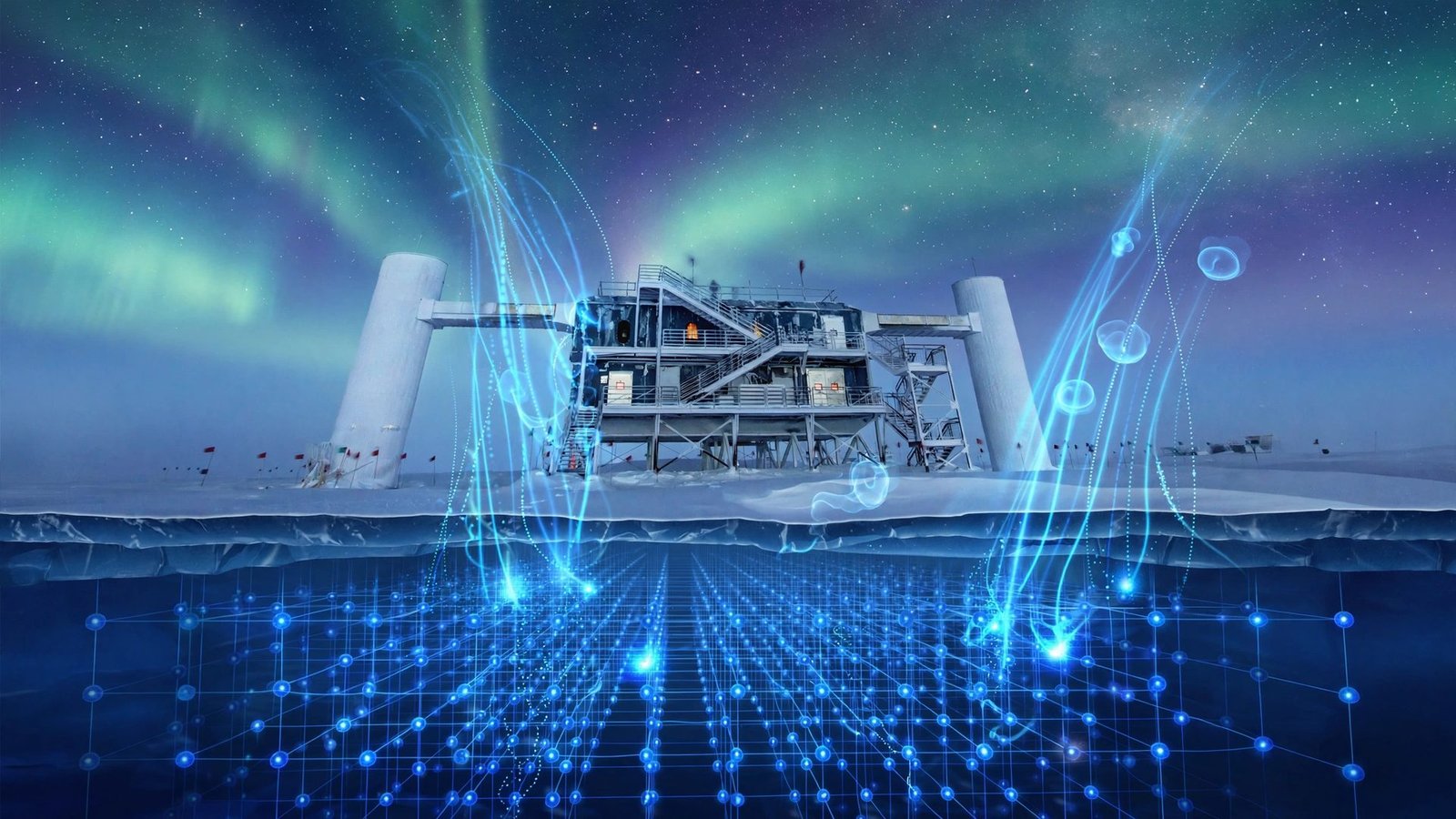
Halzen, who is based at the University of Wisconsin–Madison, first presented plans for the observatory in 1988, convinced that the clear ice at the South Pole could be turned into a giant detector for neutrinos — subatomic particles often called “ghost particles” because they pass through almost any kind of matter without a trace. Neutrinos have almost no mass and no electrical charge, and trillions of them stream through our bodies every second.
Researchers drilled kilometre-deep holes into the Antarctic ice and lowered strings of light sensors into them, exploiting the fact that neutrinos occasionally collide with atomic nuclei and produce tiny flashes of light that can be tracked. IceCube’s predecessor, AMANDA, was completed in 2000 but failed to capture the high-energy neutrinos Halzen was hunting. Construction then began on IceCube itself — a full cubic kilometre of ice equipped with 5,160 light sensors hung on 86 cables — which reached its full size in 2011.
In 2013, the research team reported the first evidence supporting the detection of cosmic neutrinos, and within a couple of years had gathered enough data to be certain of the discovery. Unlike the billions of neutrinos that stream from the Sun, these high-energy particles come from the far reaches of the cosmos and carry information about distant galaxies, exploding stars and distant objects such as black holes that are otherwise hidden behind dust clouds.
Nobel committee member Eva Olsson told the award presentation in Stockholm that the particles bring information from the cosmos, opening doors to distant galaxies and revealing the processes of exploding stars. The committee noted that IceCube would take neutrino astronomy to a new level, and a planned expansion would allow the observatory to monitor eight cubic kilometres of ice.
Speaking to the committee by telephone from Italy, Halzen called the prize a great surprise and a pleasure. Reflecting on the decades-long project, he recalled that when the work began, few people — including himself — believed it would succeed, describing it as an adventure whose outcome was never guaranteed. It took a team of hundreds of people to build it, Richard Fitzgerald, editor-in-chief of Physics Today, told CNN, adding that it all started with one person.
The physics prize was the second Nobel announced this week, following Monday’s physiology or medicine prize. The awards continue on Wednesday with chemistry, followed by literature on Thursday, peace on Friday, and the economic sciences prize on October 12. The physics award carries a cash prize of 12 million Swedish kronor, worth about $1.2 million.