Tag: Inflation

  • LPG Price Hits Rs600 per kg in Multan

    LPG Price Hits Rs600 per kg in Multan

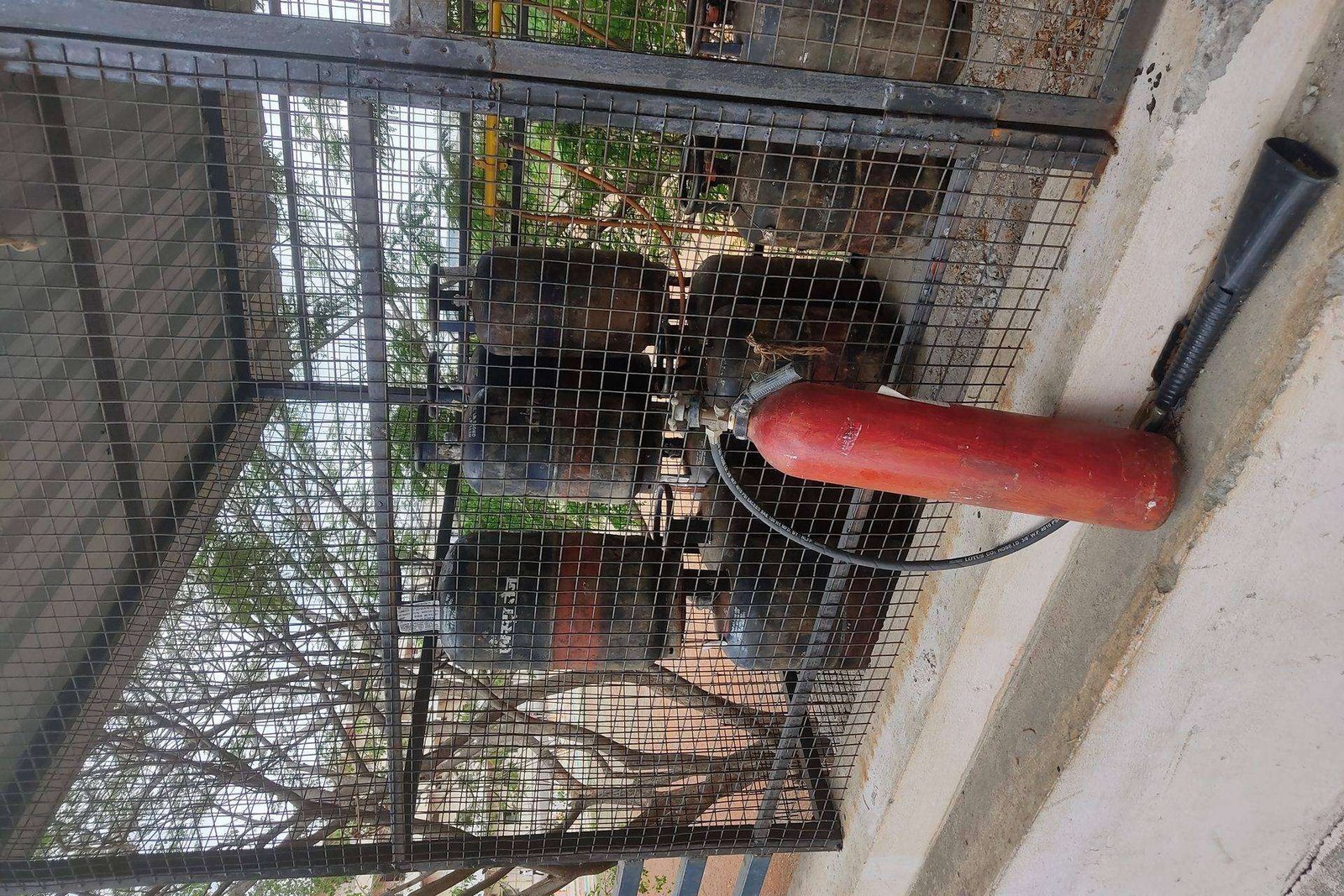
    Liquefied petroleum gas (LPG) prices in Multan have risen to Rs600 per kg, adding to the difficulties of residents as the cost of the essential fuel continues to climb across the city.

    According to reports, LPG was previously selling at Rs530 per kg in the city. Prices have since risen sharply, with the fuel now available at Rs560 per kg in some areas, while in other parts of Multan it is being sold at Rs570 and even Rs600 per kg.

    The increase has not been limited to household use. Prices of commercial cylinders have also risen sharply, with a 43-kilogram commercial gas cylinder now selling for Rs23,700, raising costs for businesses that depend on LPG for their daily operations.

    Residents have complained strongly about the continuous rise in prices, saying the repeated increases are placing a heavy burden on household budgets at a time when the weather is changing and the need for gas is growing.

    People in the city have demanded that the authorities take immediate notice of the situation and act to bring prices under control, saying ordinary consumers should not have to bear the brunt of unchecked increases in the price of an essential fuel.

    LPG is a key source of energy for cooking and heating in many homes, and any rise in its price is felt quickly in household spending. With the colder season approaching, residents say the latest increase has come at a particularly difficult time, when families are already trying to manage rising living costs.

    The difference in prices across different areas of the city has also drawn complaints from consumers, who say the same fuel should not be sold at widely different rates within Multan. Residents have urged the authorities to ensure fair pricing and strict monitoring of dealers so that no one is overcharged.

    For now, consumers in Multan are hoping for swift action from the authorities to check the rising trend and provide relief to households already struggling with the cost of living. Until prices stabilise, families say they will have to stretch already tight budgets further to meet the cost of this essential fuel.


  • KSE-100 Soars 4.5% in a Week as Oil Falls, Rupee Steadies

    KSE-100 Soars 4.5% in a Week as Oil Falls, Rupee Steadies

    The Pakistan Stock Exchange enjoyed its strongest week in months, with the benchmark KSE-100 Index jumping 4.5 percent to close at 173,887 points for the week ended 6 November.

    The index gained 7,477 points over the week from 166,409, rebounding sharply on positive global cues after the Democrats’ victory in the United States midterm elections and a steep fall in international crude oil prices. The rally added Rs520.26 billion to investors’ wealth, taking total market capitalisation to Rs18,909 billion, or about $68 billion.

    Trading activity picked up strongly. Average daily traded volume surged 43 percent to 856 million shares, while average daily traded value rose 24 percent to $103 million. On 6 November alone, some 1,480 million shares changed hands, though the index slipped 1,493 points that day as investors booked profits after the week’s gains.

    Banks and cement led the rally

    Banks were the biggest contributors to the weekly gain, adding 2,659 points to the index, followed by cement with 1,266 points, fertiliser with 988 points, power generation with 545 points and investment banks with 535 points. The refinery sector was the main drag, losing 238 points amid weak refining margins.

    Among individual stocks, Fauji Fertilizer Company contributed the most, adding 613 points, followed by Lucky Cement with 564 points, Engro Holdings with 519 points, United Bank Limited with 491 points and Meezan Bank with 480 points. Attock Refinery and Cnergyico were the biggest drags, while Cnergyico was also the week’s most traded stock, with average volume of 75.8 million shares.

    Pak Suzuki Electric led the weekly gainers, rising 26.7 percent, while Pioneer Cement and D.G. Khan Cement both climbed 12.5 percent. Cnergyico fell 11.3 percent and Attock Refinery dropped 9.8 percent, the week’s sharpest declines among index stocks.

    Cooling inflation and cheaper fuel helped

    The rally was backed by improving economic numbers. Inflation eased to 9.6 percent year-on-year in October, down from 10.3 percent in September, according to official data cited by brokerage research. The government raised Rs385.6 billion in a Treasury bill auction against a target of Rs350 billion.

    Cheaper fuel also lifted sentiment. Petrol prices fell to Rs352.59 a litre from Rs377.91, and diesel to Rs382.25 from Rs402.96, after the drop in global oil prices. Pakistan’s trade deficit stood at $3.9 billion in October, with exports rising 2.8 percent to $2.9 billion and imports up 11.8 percent to $6.8 billion.

    The rupee was steady, closing marginally firmer at Rs276.66 to the dollar. Analysts expect the market to stay sensitive to developments in the US-Iran talks and to oil prices, with the MSCI index review due on 11 November also in focus. The KSE-100 is currently trading at a price-to-earnings ratio of 7.3 times, offering a dividend yield of 6.8 percent.

  • Petrol Falls to Rs346 a Litre in Fifth Straight Cut

    Petrol Falls to Rs346 a Litre in Fifth Straight Cut

    Petrol in Pakistan now costs Rs346 a litre and high-speed diesel Rs378, after the Oil and Gas Regulatory Authority (OGRA) cut prices for the fifth day in a row, bringing a week of steady relief at the pump for motorists and transporters.

    OGRA’s notification, issued on Friday, reduced the price of petrol by Rs6.59 a litre, from Rs352.59 to Rs346.00, and high-speed diesel by Rs4.25 a litre, from Rs382.25 to Rs378.00. The new rates took effect on Saturday, 7 November, and will remain in force until Tuesday, 10 November, because Monday, 9 November, is a public holiday.

    The latest cut caps a remarkable week for fuel prices. Petrol has fallen by Rs31.91 a litre since 31 October, when it stood at Rs377.91, a drop of about 8.4 per cent. Diesel has come down by Rs24.96 a litre over the same period, from Rs402.96 to Rs378.00. The cuts have arrived almost every day: petrol was reduced by Rs3.40 on 3 November, Rs5.45 on 4 November, Rs7.06 on 5 November and Rs9.41 on 6 November, before Friday’s Rs6.59 cut.

    Why prices are falling

    The relief is driven by two factors. World crude oil prices have softened, and the federal government has moved to a daily pricing system, with the cabinet and the prime minister entrusting OGRA to set fuel prices each day on the basis of international market conditions, rather than waiting for the old fortnightly cycle.

    The current round of relief is also supported by a 30-day arrangement under which oil refineries contribute to the petroleum levy, absorbing a cumulative impact of about Rs15 billion. That deal runs for the rest of the month, which is one reason officials describe the daily cuts as temporary rather than permanent.

    It is important to note that the latest cut is not a tax cut. Taxes and duties inside the pump price have not changed. Petrol still carries about Rs114 a litre in taxes, and diesel about Rs100 a litre, according to official pricing data.

    What it means for households

    For a motorist filling a 40-litre tank, the week’s slide has taken the cost of a full tank of petrol down by nearly Rs1,280 compared with the end of October. Transporters, who run on diesel, have seen a similar saving, and lower diesel prices usually ease pressure on the cost of moving goods, including food, across the country.

    The next revision is expected after the 9 November public holiday, when OGRA will publish fresh prices. Whether the run of daily cuts continues will depend on two things: world oil prices and the refinery levy arrangement. For now, motorists have until 10 November to enjoy the lowest petrol price in months.

  • Shehbaz Vows More Relief as Petrol Prices Set to Fall

    Shehbaz Vows More Relief as Petrol Prices Set to Fall

    Prime Minister Shehbaz Sharif has signalled further cuts in petroleum prices, saying his government will keep bringing relief to people struggling with the rising cost of living.

    The prime minister made the remarks during a meeting with senior Pakistan Muslim League-Nawaz leader Khawaja Ahmad Hassan at Model Town in Lahore on Saturday, where the two discussed the country’s political and economic situation.

    According to reports of the meeting, the prime minister said petroleum prices were being reduced gradually and that steps to protect the public from inflation would continue. He said the government would keep introducing measures aimed at easing the burden on ordinary households.

    Khawaja Ahmad Hassan praised the prime minister for extending petrol subsidies to the public without discrimination, describing it as a positive step for public welfare. He said millions of people had directly benefited from the fuel subsidy and that billions of rupees had been spent on providing relief.

    Hassan also welcomed the diplomatic efforts of the prime minister and Field Marshal Asim Munir in promoting peaceful solutions to international conflicts, saying their work had received wide recognition at the international level.

    The meeting comes against the backdrop of the government’s targeted fuel relief scheme, under which petrol is being provided at reduced prices to owners of motorcycles, rickshaws and small vehicles of up to 800cc. Information Minister Attaullah Tarar said earlier this week that more than 15 million people had registered under the scheme and that relief worth Rs27 billion had been provided so far.

    The government also averted a planned Rs15 per litre increase in petrol prices this week, with the additional burden instead shifted to refineries, according to the information minister. The prime minister has separately directed action against petrol pumps that fail to pass on the relief to consumers.

    Petrol prices matter deeply to household budgets in Pakistan, where fuel costs feed directly into transport fares and the prices of everyday goods. Any further reduction would bring some respite to low-income families, motorcycle riders and small traders who depend on affordable fuel for their livelihoods.

    For now, the prime minister’s message is one of reassurance: that the relief measures already in place are only the beginning, and that more help is on the way for people feeling the pinch of inflation.

  • Inflation eases to 9.61% in October, back in single digits

    Inflation eases to 9.61% in October, back in single digits

    Pakistan’s annual inflation rate fell to 9.61 per cent in October 2026, returning to single digits after two months above 10 per cent, according to data released by the Pakistan Bureau of Statistics. The figure marks the first single-digit annual reading since July, offering some relief after a summer in which price pressures had picked up again.

    The bureau’s monthly report showed the annual rate easing from 10.3 per cent in September to 9.61 per cent in October. Inflation had climbed above 10 per cent in August and stayed there in September, so the October decline breaks that run, even though the rate remains well above the State Bank’s target range of 5 to 7 per cent. For households, the direction of travel matters, but the level still means prices are rising much faster than policymakers would like.

    The improvement in the annual rate did not mean prices stopped rising. Consumer prices increased by 1.1 per cent in October compared with September, showing that month-on-month pressures continued. Rural areas felt that monthly increase more sharply, with prices up 1.5 per cent on the month, against 0.8 per cent in urban areas. On an annual basis, rural inflation stood at about 9.8 per cent in October, compared with 9.5 per cent in urban areas.

    The broader picture for the fiscal year remains less comfortable. Average inflation during the first four months of the current fiscal year, from July to October 2026, remained in double digits at 10.05 per cent. That average reflects the higher readings in August and September, and it shows that a single month of cooling does not by itself undo the pressure built up over the summer.

    Food provided some of the relief in October. Food inflation eased to 7.74 per cent from 8.2 per cent in September, helped by a fall in perishable food prices, which dropped 2.35 per cent on the month after a sharp rise the month before. At the same time, price growth in transport quickened further, reaching 28.61 per cent from 27.43 per cent, a reminder that energy and fuel costs continue to feed through to household budgets.

    The comparison with a year ago underlines how much has changed. Inflation in October 2026, at 9.61 per cent, was considerably higher than the 6.2 per cent recorded in October 2025. The Finance Division had projected October inflation in a range of 9.5 to 10.5 per cent, so the official figure landed comfortably inside that forecast, but at a level far above last year’s.

    What happens next will depend heavily on international energy prices, food supplies and base effects, the factors the Finance Division itself flagged as risks to the outlook. The State Bank raised its policy rate to 12 per cent in late October to guard against second-round price effects, a move that raises borrowing costs but is intended to anchor expectations.

    For now, October’s data gives the government a welcome headline: inflation back in single digits. Whether that becomes a sustained trend, rather than a one-month pause, will be decided by the November figures and by whether the monthly price increases that continued in October begin to fade.

  • Pakistan inflation to stay at 9.5-10.5% in October

    Pakistan inflation to stay at 9.5-10.5% in October

    Pakistan’s inflation is expected to stay elevated in October, with the Finance Division projecting a range of 9.5 to 10.5 per cent for the month. In its Monthly Economic Update and Outlook for October 2026, the division described rising inflation as a key downside risk to the country’s economic outlook, pointing to persistent geopolitical tensions, recurring conflicts in the Gulf region, volatile international oil prices, trade disruptions and rising global inflationary pressures.

    According to the report, headline inflation eased to 10.3 per cent in September from 11.1 per cent in August, but the future path remains vulnerable to movements in international energy prices, food supplies and base effects. Average headline Consumer Price Index inflation stood at 10.2 per cent during July to September of the current fiscal year, compared with 4.3 per cent in the corresponding period of the previous year.

    Energy costs were a major driver. Brent crude averaged 116.8 dollars per barrel in September, registering a 28.4 per cent increase over August, while natural gas prices also moved upward. The Food and Agriculture Organisation’s Food Price Index increased by 1.5 per cent to 136 points, and rising palm oil and fertiliser prices further increased import costs and agricultural input expenses.

    The pressure on households was visible in September’s price data. Transport prices recorded a year-on-year increase of 27.4 per cent, while housing, water, electricity, gas and fuel costs rose by 12.4 per cent. Perishable food prices increased by 11.8 per cent, whereas non-perishable food prices went up by 7.6 per cent.

    Growth, industry and the external account

    Revised national accounts data placed economic growth at 3.65 per cent for the last fiscal year, slightly below the earlier estimate of 3.70 per cent. Agriculture recorded growth of 3.50 per cent, while industry and services expanded by 3.34 per cent and 3.81 per cent respectively. Large-scale manufacturing grew by 1.9 per cent during July and August, considerably lower than the 4.8 per cent growth registered in the same period last year, and output in August rose by 0.7 per cent year on year but fell by 5 per cent compared with July.

    On the external front, the current account deficit widened to 874 million dollars during July to September, compared with 755 million dollars a year earlier, mainly because imports increased faster than exports. Goods imports rose by 14.3 per cent to 17.8 billion dollars, while exports increased by 7.7 per cent to 8.5 billion dollars. Workers’ remittances provided significant support, growing by 14 per cent to 10.9 billion dollars. By October 16, the State Bank of Pakistan’s liquid reserves stood at 21.5 billion dollars, while total liquid reserves reached 26.8 billion dollars.

    The report also noted a 3 billion dollar Eurobond issuance in September and tax collection up by 7 per cent to 3,086.2 billion rupees. The Monetary Policy Committee increased the policy rate by 50 basis points to 12 per cent, effective October 27, in response to rising inflationary risks linked to Middle East tensions and persistently high international energy prices. The Finance Division concluded that while improved agricultural output, reserves, remittances and international financing should support activity, continued progress in tax administration, energy efficiency and reforms of state-owned enterprises will be critical to sustaining growth and containing inflation.

  • پیٹرول 88 پیسے، ڈیزل 53 پیسے فی لیٹر مہنگا

    پیٹرول 88 پیسے، ڈیزل 53 پیسے فی لیٹر مہنگا

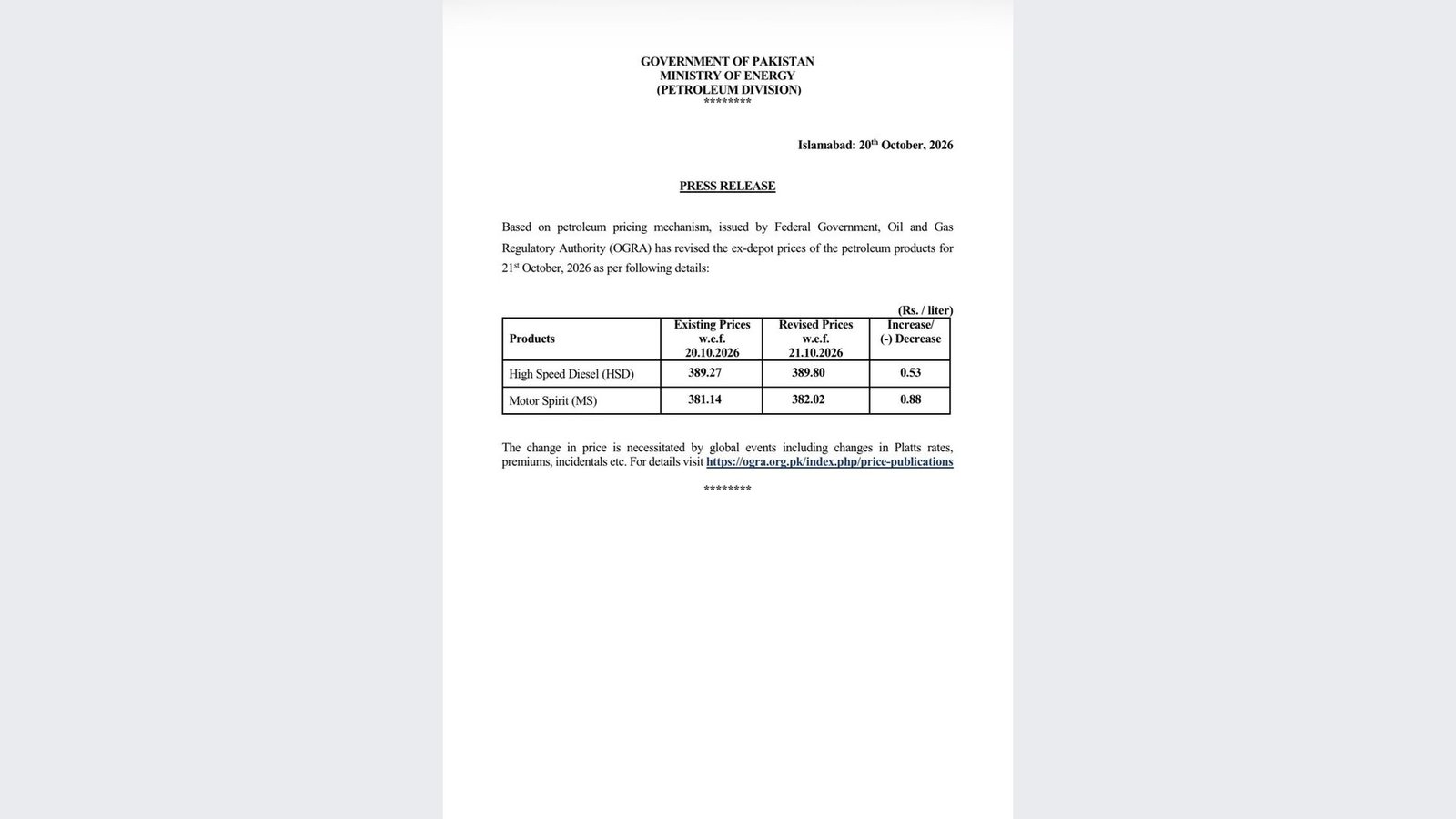
    اسلام آباد: وفاقی حکومت نے پیٹرولیم مصنوعات کی قیمتوں میں رد و بدل کرتے ہوئے اگلے ایک روز کے لیے پیٹرول اور ہائی اسپیڈ ڈیزل کی قیمتیں بڑھا دی ہیں۔

    پیٹرولیم ڈویژن کی جانب سے جاری کردہ نوٹیفکیشن کے مطابق پیٹرول کی فی لیٹر قیمت میں 88 پیسے کا اضافہ کیا گیا ہے، جس کے بعد پیٹرول کی قیمت 381 روپے 14 پیسے سے بڑھ کر 382 روپے 02 پیسے فی لیٹر ہو گئی ہے۔

    اسی طرح ہائی اسپیڈ ڈیزل کی فی لیٹر قیمت میں 53 پیسے کا اضافہ ہوا ہے، جس کے بعد ڈیزل کی قیمت 389 روپے 27 پیسے سے بڑھ کر 389 روپے 80 پیسے فی لیٹر مقرر ہو گئی ہے۔

    نوٹیفکیشن کے مطابق نئی قیمتوں کا اطلاق 21 اکتوبر 2026 کے لیے ہوگا۔ آئل اینڈ گیس ریگولیٹری اتھارٹی (اوگرا) نے وفاقی حکومت کے جاری کردہ روزانہ قیمتوں کے نظام کے تحت پیٹرولیم مصنوعات کی ایکس ڈپو قیمتوں میں یہ رد و بدل کیا ہے۔

    روزانہ قیمتوں کا نظام

    وفاقی وزیر پیٹرولیم علی پرویز ملک کے مطابق پیٹرولیم مصنوعات کی قیمتوں کا تعین بین الاقوامی منڈی میں گزشتہ سات روز کی اوسط قیمتوں کی بنیاد پر کیا جاتا ہے، جو عالمی طریقہ کار کے مطابق ہے۔

    بزنس ریکارڈر کے مطابق قیمتوں میں اس تبدیلی کی وجہ عالمی واقعات ہیں، جن میں پلیٹس ریٹس، پریمیم اور دیگر اخراجات میں تبدیلیاں شامل ہیں۔ نوٹیفکیشن میں بتایا گیا ہے کہ پیٹرول اور ڈیزل کی درآمدی لاگت میں اضافہ ہوا ہے، جبکہ لیویز اور منافع کی شرح میں کوئی تبدیلی نہیں کی گئی۔

    پیٹرول اور ڈیزل دونوں پر پیٹرولیم لیوی 80 روپے فی لیٹر اور کلائمیٹ سپورٹ لیوی 5 روپے فی لیٹر برقرار رہے گی۔ ڈیلرز کے لیے 9 روپے 98 پیسے اور آئل مارکیٹنگ کمپنیوں کے لیے 7 روپے 87 پیسے فی لیٹر منافع کی شرح بھی بدستور قائم ہے۔

    واضح رہے کہ حکومت نے بین الاقوامی تیل منڈی میں اتار چڑھاؤ کو جلد سے جلد مقامی قیمتوں میں ظاہر کرنے کے لیے روزانہ قیمتوں کا نظام اپنایا ہے۔ اس نظام کے تحت اوگرا اب وزیراعظم یا وفاقی حکومت کی پیشگی منظوری کے بغیر روزانہ قیمتیں جاری کر سکتا ہے، جبکہ جمعہ کو جاری کی گئی قیمتیں ہفتہ اور اتوار کو برقرار رہتی ہیں۔

    قیمتوں میں یہ اضافہ ایک روز قبل کی گئی نمایاں کمی کے بعد سامنے آیا ہے۔ بول نیوز کے مطابق 20 اکتوبر کو پیٹرول کی قیمت میں 5 روپے 16 پیسے اور ڈیزل کی قیمت میں 7 روپے 69 پیسے فی لیٹر کمی کی گئی تھی، جس کے بعد نئی قیمتیں نافذ ہوئی تھیں۔

    اس سے قبل حکومت نے مشرق وسطیٰ میں جاری کشیدگی کے باعث ہفتہ وار قیمتوں کا نظام اپنایا تھا، جبکہ اب روزانہ قیمتوں کے نظام سے بین الاقوامی منڈی کی تبدیلیاں فوری طور پر صارفین تک پہنچیں گی۔ ماہرین کے مطابق روزانہ قیمتوں کا نظام شفافیت بڑھائے گا، تاہم صارفین کو قیمتوں میں بار بار تبدیلی کا سامنا رہے گا۔