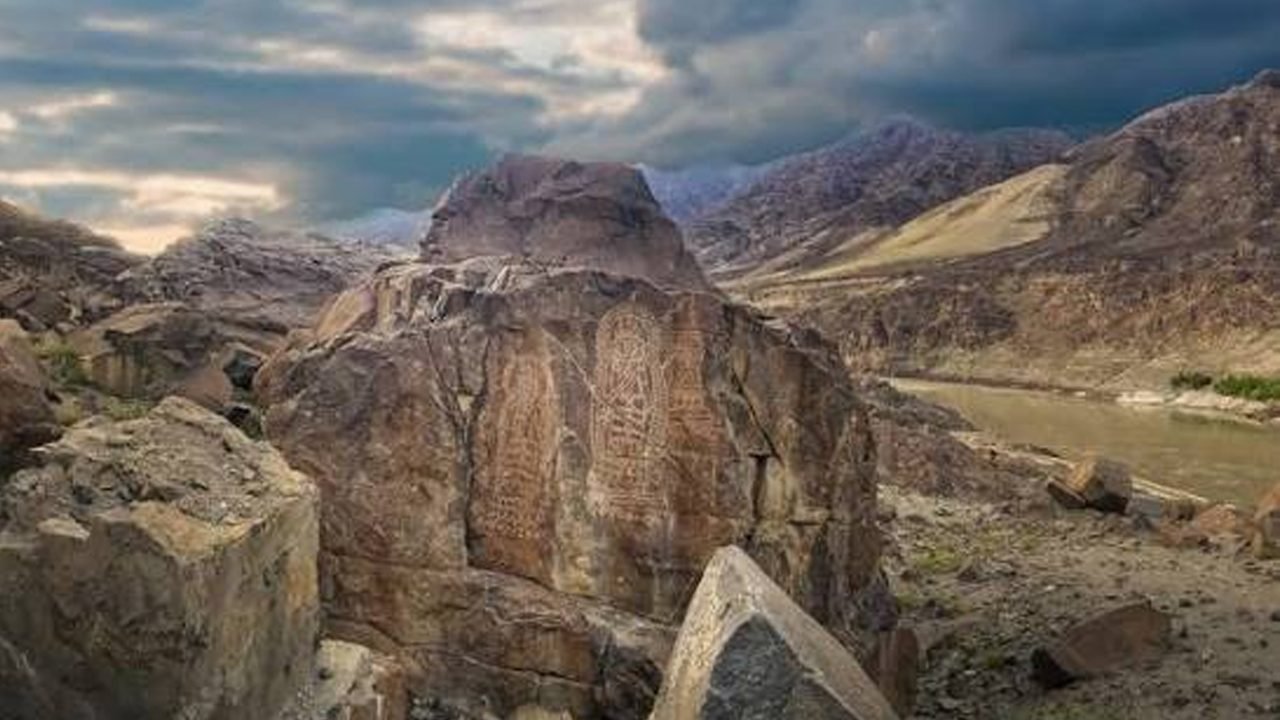
In the northern areas of Pakistan, near the town of Chilas in Diamer district, Gilgit-Baltistan, lies Thalpan — a place where the rocks themselves tell the story of ancient civilisations. Pictures and inscriptions carved into boulders and cliffs thousands of years ago still survive here, offering a rare window into the lives of the people who once lived, travelled and worshipped in the Upper Indus region.
According to the Department of Archaeology Pakistan, some of the carvings at Thalpan date from the 9th to 8th millennium BC, among the oldest rock art in the region. The carvings depict ancient people’s daily lives: hunting scenes, wild animals, and scenes of religion and culture. One shows a predator hunting a deer, a vivid snapshot of a world long gone.
The scale of the site is remarkable. Research records show that around Chilas and Thalpan, in roughly a 100-kilometre stretch of the upper Indus, more than 50,000 rock carvings, known as petroglyphs, and more than 5,000 ancient inscriptions have been found, spanning from the late Stone Age and the Epipalaeolithic-Neolithic period to the coming of Islam in the 16th century.
The inscriptions are written in many ancient writing systems, including Brahmi, Kharosthi, Sogdian, Chinese, Tibetan and Proto-Sharada. Researchers say this variety shows that the region was home to, and visited by, people from many different cultures and traditions over thousands of years.
A crossroads of faith and trade
Thalpan is also rich in Buddhist carvings. Stupas, religious figures and scenes from the life of the Buddha are etched into the rock, showing that the region was a religious and cultural crossroads in different eras. Travellers, traders and pilgrims passing through left their mark on the stones, recording their beliefs as well as their journeys.
The area lay on the ancient Silk Road, the network of routes that once connected distant lands through trade and travel. The rocks of Thalpan are a record of that world — of the people who lived, travelled, traded, hunted and worshipped along the Upper Indus.
Much of what is known today comes from the Pak-German Archaeological Mission, run by the Heidelberg Academy in Germany. German archaeologist Harald Hauptmann led the work from 1989, documenting the carvings in detail. Famous examples include the Altar Rock at Thalpan and the Hungry Tigress Jataka carving at Chilas, which depicts a scene from a Buddhist tale.
A race against the rising water
Today, however, the future of many of these carvings is uncertain. The reservoir of the Diamer-Basha Dam will submerge a large share of them, with estimates saying tens of thousands of carvings — around 30,000 to 35,000 — could be affected. Archaeologists are working to document the carvings before the water rises, using photography, 3D scanning and modelling to create a detailed record.
According to researchers, a cultural heritage management plan also covers preservation, a museum and tourism promotion, so the story told by the rocks is not lost even if many carvings disappear beneath the reservoir. For now, the work continues, and Thalpan remains one of Pakistan’s most important windows into its ancient past — a history written not in books, but in stone.