Tag: Ceasefire

  • Pakistan, 17 Nations Condemn Israeli Strike on Gaza Hospital

    Pakistan, 17 Nations Condemn Israeli Strike on Gaza Hospital

    Pakistan, along with 16 other countries, has strongly condemned an Israeli airstrike on the Nasser Medical Complex in Khan Younis, Gaza, which caused casualties among patients and healthcare workers. In a joint statement issued on Saturday, the foreign ministers of the 17 countries described the attack as a violation of international humanitarian law, which affords special protection to medical facilities and healthcare personnel.

    According to Pakistan’s Foreign Office, the joint statement was issued by the foreign ministers of Pakistan, Egypt, Saudi Arabia, Turkiye, Jordan, Qatar, the United Arab Emirates, Indonesia, Palestine, Algeria, Mauritania, Sudan, Libya, Djibouti, Somalia, Lebanon and Oman. The ministers stressed that hospitals and medical staff must be protected under international law, and that attacks on them cannot be justified under any circumstances.

    The statement also denounced continued Israeli attacks on Palestinian civilians, including strikes targeting tents and other locations sheltering displaced people. The foreign ministers warned that such attacks undermine the ceasefire and the ongoing efforts to restore security and stability in Gaza, and that they are inconsistent with United States President Donald Trump’s Comprehensive Plan for the territory.

    The ministers expressed grave concern over Israel’s continued restrictions on humanitarian assistance, including shelter materials such as tents, caravans and mobile homes, as well as essential medical supplies. They warned that these restrictions are worsening the humanitarian crisis in Gaza as winter approaches, at a time when many families are already living in damaged or makeshift shelter.

    According to the statement, inadequate shelter and deteriorating water, sanitation and healthcare services pose serious threats to civilian lives, particularly children and infants, who face the risk of dying from exposure to freezing temperatures. The foreign ministers said the situation required urgent action to ensure that aid reaches those who need it most.

    The foreign ministers urged Israel to uphold the ceasefire, ensure the uninterrupted delivery of humanitarian aid and fulfil its obligations under the Sharm El-Sheikh Agreement, Trump’s Comprehensive Plan and United Nations Security Council Resolution 2803 (2025). They also called for unrestricted access for United Nations agencies and humanitarian organisations so that they can carry out their mandates in Gaza.

    Reaffirming their commitment to working with regional and international partners, the ministers pledged to consolidate the ceasefire, implement all phases of the plan and expand humanitarian assistance to ease the suffering of the Palestinian people. Pakistan’s Foreign Office said Pakistan would continue to raise its voice for the protection of civilians and for a just and lasting peace in the region.
  • غزہ: ناصر ہسپتال پر اسرائیلی حملہ، ڈاکٹر اور بچہ سمیت 6 جاں بحق

    غزہ: ناصر ہسپتال پر اسرائیلی حملہ، ڈاکٹر اور بچہ سمیت 6 جاں بحق

    جنوبی غزہ کے شہر خان یونس میں واقع ناصر ہسپتال پر بدھ کی رات آدھی رات کے فوراً بعد اسرائیلی حملہ ہوا جس سے ہسپتال کی سرجری یونٹ تباہ ہو گئی۔ فلسطینی حکام کے مطابق حملے میں کم از کم 6 افراد جاں بحق ہوئے جن میں ایک ڈاکٹر اور 13 سالہ بچہ بھی شامل ہے۔

    غزہ سول ڈیفنس کے ترجمان عزالدین ابو صباح نے بتایا کہ حملہ رات کے اندھیرے میں ہسپتال کی عمارت پر ہوا اور تباہ شدہ یونٹ میں جلی ہوئی ملبے بکھر گئی۔ ان کے مطابق جاں بحق ہونے والوں میں 52 سالہ ڈاکٹر رزق ابو شعیرہ بھی شامل ہیں جبکہ 13 سالہ لڑکے کی سرجری ہونی تھی۔ حملے میں 40 افراد زخمی ہوئے جن میں دو ڈاکٹر شدید زخمی ہیں۔

    حملے کے بعد ہسپتال کے اندر بنائی گئی ویڈیو میں تباہی کے مناظر دیکھے جا سکتے ہیں — چھتیں گر چکی ہیں، بستر الٹے پڑے ہیں اور یونٹ کا فرش ملبے سے ڈھکا ہوا ہے۔ ویڈیو میں دو بم بھی نظر آئے جن میں سے ایک پھٹ نہیں سکا۔ نہ پھٹنے والے بم پر لگے لیبل سے معلوم ہوا کہ یہ امریکہ کا بنایا ہوا جی بی یو-39/بی بم ہے جس کا وزن 250 پاؤنڈ ہے اور یہ اسرائیل کو فراہم کیا گیا تھا۔

    وارڈ میں موجود مریضوں نے بتایا کہ وہ دھول اور ٹوٹے ہوئے شیشوں میں جاگے۔ ہسپتال کے ایک بزرگ مریض عطیہ ابو بصیر نے کہا: ”میں سو رہا تھا کہ اچانک میں دھول اور شیشوں سے ڈھک گیا۔ میں چل نہیں سکتا تھا کیونکہ ابھی میری سرجری ہوئی تھی۔“

    غزہ کی وزارت صحت کے ڈائریکٹر جنرل ڈاکٹر منیر البرش نے حملے کے بعد فیس بک پر لکھا: ”دنیا کے لوگو… غزہ کے لوگ کہاں جائیں؟ خیمے ڈوب رہے ہیں، چٹانیں بچوں پر گر رہی ہیں اور ہسپتالوں پر اندر موجود لوگوں سمیت بمباری ہو رہی ہے۔ کمبل — یا آنسو — خشک ہونے کا وقت ہی نہیں۔“ انہوں نے مزید لکھا: ”غزہ دنیا سے اپنے مرنے والوں کو گننے کا نہیں کہتا… وہ اب بھی زندہ لوگوں کی حفاظت کا مطالبہ کرتا ہے۔“

    اسرائیلی فوج (آئی ڈی ایف) نے ایک بیان میں کہا کہ اس نے حماس کی خان یونس بریگیڈ کے کمانڈر محمد ابو اسماعیل کو نشانہ بنایا تھا اور ان کے ساتھ ”ناصر ہسپتال میں چھپے ہوئے مزید دہشت گردوں“ کو بھی۔ آئی ڈی ایف کے مطابق ابو اسماعیل اسرائیلی فوجیوں اور شہریوں پر حملوں کی منصوبہ بندی کر رہا تھا۔ سی این این نے بتایا کہ اس نے آئی ڈی ایف سے پوچھا ہے کہ کیا ابو اسماعیل اس حملے میں مارا گیا اور شہریوں کو خطرے سے بچانے کے لیے کیا اقدامات کیے گئے تھے۔

    یہ حملہ اس وقت ہوا جب ایک سال سے زیادہ عرصہ قبل امریکہ کی ثالثی میں جنگ بندی کا معاہدہ ہوا تھا، جس کے باوجود اسرائیل غزہ میں تقریباً روزانہ حملے کر رہا ہے۔ اقوام متحدہ کے مطابق جنگ بندی کے بعد سے اسرائیلی فورسز نے غزہ میں 1,400 سے زیادہ افراد کو ہلاک کیا ہے اور تباہ شدہ علاقے میں کوئی بھی ہسپتال مکمل طور پر فعال نہیں رہا۔

    مریم ابو حطب، جن کا بھائی اس حملے میں جاں بحق ہوا، نے جنگ بندی پر سوال اٹھایا۔ انہوں نے کہا: ”وہ کہتے ہیں جنگ بندی ہے۔ جنگ بندی کہاں ہے؟ جنگ بندی کے بعد سے قتل عام اور بڑھ گیا ہے۔ ہر روز بازاروں میں، یونیورسٹیوں میں، سڑکوں پر قتل عام ہو رہا ہے۔ گدھا گاڑیاں دنیا کے ممالک سے زیادہ ہمارے ساتھ کھڑی رہیں۔“

    اس ہفتے کے شروع میں غزہ میں جنگ بندی کی نگرانی کرنے والے امریکہ کی قیادت والے بورڈ آف پیس نے اسرائیل کو غزہ میں سیلاب پر ”ناکافی“ ردعمل پر تنقید کا نشانہ بنایا۔ موسمی بارشوں نے ساحلی علاقے میں دسیوں ہزار خیمے ڈبو دیے ہیں جہاں اقوام متحدہ کے مطابق تقریباً 20 لاکھ فلسطینی بے گھر ہیں۔ بورڈ نے کہا کہ شہریوں کی حفاظت کے لیے پناہ گاہوں، صفائی، نکاسی آب اور موسم سرما کی دیگر ضروری اشیاء کی فوری فراہمی نہایت اہم ہے اور اسرائیل سے مطالبہ کیا کہ وہ مزید عارضی پناہ گاہیں اور کچرے کے انتظام کی سہولت کی اجازت دے۔ اسرائیل نے کہا کہ موسم سرما سے قبل 91,000 سے زیادہ خیمے غزہ میں داخل ہو چکے ہیں لیکن اس نے بڑے پیمانے پر صفائی اور ملبہ ہٹانے کے لیے بھاری مشینری کی اجازت دینے سے انکار کر دیا۔ اسرائیل کے کوآرڈینیٹر برائے سرکاری سرگرمیاں برائے علاقوں نے کہا: ”غزہ کی تعمیر نو صرف اس وقت شروع ہو سکتی ہے جب حماس مکمل طور پر ہتھیار ڈال دے۔“

  • Israeli Strike on Gaza Hospital Kills at Least 6

    Israeli Strike on Gaza Hospital Kills at Least 6

    Nasser Hospital in Khan Younis, in southern Gaza, was struck shortly after midnight on Wednesday in an Israeli attack that tore through its surgery unit, Palestinian officials said. At least six people were killed, among them a doctor and a 13-year-old boy.

    The Gaza Civil Defense spokesman, Ezz Eddine Abu Sabha, said the strike hit the hospital complex in the dark of night and left charred debris scattered across the destroyed unit. The dead included 52-year-old Dr. Rizk Abu Shaira, he said, and a boy who had been due to undergo surgery. Forty people were wounded in the attack, including two doctors who are in critical condition.

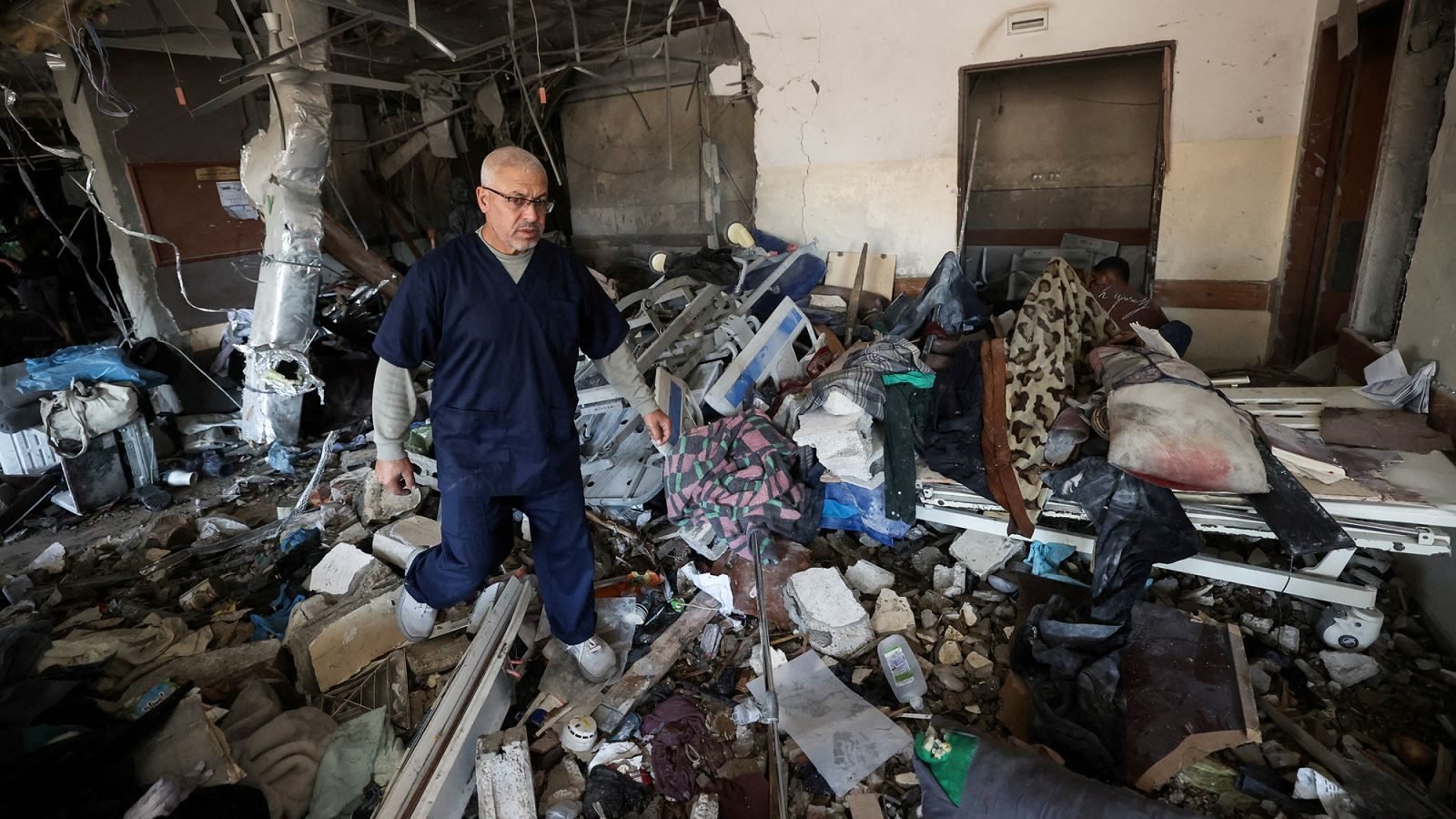
    Footage filmed inside the hospital after the strike showed the scale of the damage, with ceilings collapsed, beds overturned and rubble covering the floor of the unit. The footage also showed two bombs, one of which failed to explode. A label on the unexploded bomb identified it as a US-manufactured GBU-39/B, a 250-pound bomb that has been supplied to Israel.

    Patients caught inside the ward described waking to dust and broken glass. “I was asleep when suddenly I was covered with dust and glass,” said Atiya Abu Basir, an elderly patient at the hospital. “I couldn’t walk because I just had surgery.”

    Dr. Munir Al-Bursh, director-general of Gaza’s Health Ministry, wrote on Facebook after the strike: “People of the world… where can the people of Gaza go? Tents flood, cliffs collapse onto children, and hospitals are bombed with people inside. There is no time for blankets – or tears – to dry.” He added: “Gaza does not ask the world to count its dead… It demands protection for those still alive.”

    In a statement, the Israel Defense Forces (IDF) said they had targeted the commander of Hamas’ Khan Younis Brigade, Muhammad Abu Ismail, as well as “additional terrorists who were hiding inside the Nasser Hospital in Khan Younis.” The IDF said he had planned and advanced attacks on Israeli forces and civilians. CNN said it had asked the IDF whether Abu Ismail had been killed in the strike and what measures were taken to reduce the risk to civilians.

    The strike came despite a nominal US-brokered ceasefire signed more than a year ago, under which Israel has continued to carry out near-daily strikes in Gaza. According to the United Nations, Israeli forces have killed more than 1,400 people in Gaza since the ceasefire, and there is no fully functioning hospital left in the devastated enclave.

    Maryam Abu Hatab, whose brother was killed in the strike, questioned the ceasefire. “They say there is a ceasefire. Where is there a ceasefire? Since the ceasefire, there are more massacres,” she said. “There are massacres every day in markets, in universities, in the streets. The donkey carts stood by us more than the world’s countries.”

    Earlier this week, the US-led Board of Peace, which oversees the ceasefire in Gaza, chided Israel for what it called an “insufficient” response to flooding in Gaza. Seasonal rains have swamped tens of thousands of tents across the coastal enclave, where nearly two million Palestinians are displaced, according to the United Nations. The board said the urgent entry and distribution of shelter, sanitation, drainage and other winter supplies was critical to protecting civilians, and called on Israel to allow in more temporary shelters and waste management support. Israel said more than 91,000 tents had entered Gaza ahead of winter, but refused to allow in the heavy equipment needed for large-scale cleanup and rubble removal. “The reconstruction of Gaza can only begin after Hamas fully disarms,” said Israel’s Coordinator for Government Activities in the Territories.

  • Gaza Hospital Strike Kills 6, Wounds 20 in Khan Younis

    Gaza Hospital Strike Kills 6, Wounds 20 in Khan Younis

    An early-morning strike hit the surgery department of Nasser Hospital in Khan Younis on Thursday, killing at least six people and wounding more than 20, according to Gaza’s Civil Defence agency. The blast struck the largest hospital still operating in the southern Gaza Strip, wrecking wards that were treating patients and sheltering families who had fled their homes.

    The strike hit the second floor of the Al-Yasin building inside the Nasser Medical Complex, in the western part of Khan Younis, the Civil Defence said. Its spokesman, Mahmoud Basal, told the AFP news agency that the bodies of those killed and more than 20 wounded people had been recovered from the building. Nasser Hospital confirmed the six deaths in a statement of its own.

    Medics identified one of the dead as Rezik Abushira, a surgeon at the hospital. The hospital’s director said the explosion caused extensive damage to the intensive care and surgical wards. Early reports during the night had put the death toll at four, before rescue teams revised the figure upwards to six.

    Israel’s military has not confirmed that it carried out the strike or said what it was targeting. A military spokesperson told AFP that it was checking for information about the incident when asked for comment.

    The attack comes thirteen months into a ceasefire that took effect on 10 October 2025, after two years of war. Israel and Hamas have accused each other of violating the truce, and deadly incidents have continued despite it. On Tuesday, Israeli forces killed seven people in the Gaza Strip, including a 13-year-old boy, according to local emergency services, while the Israeli military said it had targeted what it described as military operatives.

    More than 1,590 Palestinians have been killed since the start of the ceasefire, according to the Gaza Ministry of Health, whose figures are considered reliable by the United Nations. During the same period, the Israeli military has reported the loss of seven soldiers and one civilian contractor.

    Nasser Hospital is the main medical facility in southern Gaza and one of the last major hospitals still operating in the area. It has been hit before: a double Israeli strike on the hospital in August 2025 killed at least 20 people, including journalists and health workers, according to the BBC.

    The casualty figures from Thursday’s strike come from Gaza’s Civil Defence, a rescue agency operating under the Hamas-run administration in Gaza, and from the hospital itself. They have not been independently verified, and rescue teams were still working at the site as the death toll was confirmed.

  • Israeli Fire Kills 7 in Gaza, Including Father and Son

    Israeli Fire Kills 7 in Gaza, Including Father and Son

    Israeli forces killed at least seven Palestinians in the Gaza Strip on Tuesday, local health officials said, including a father and his 13-year-old son in an airstrike on a displacement shelter in Gaza City.

    Medics said Fadi Rajab and his son Abubakr were killed when an airstrike hit the roof of a building sheltering displaced people in the Zeitoun neighbourhood of Gaza City. His wife was moderately injured in the same strike. A third Palestinian was killed in an Israeli airstrike near a school in Gaza City’s Daraj neighbourhood, health officials added.

    In Khan Younis, in southern Gaza, Israeli gunfire killed a man, medics said. Later on Tuesday, an Israeli airstrike hit a metal foundry in the Sabra neighbourhood of Gaza City, killing three people, medics said, taking the day’s death toll to at least seven.

    The Israeli military said it had struck militants in both areas of Gaza City, without giving further details. It did not immediately comment on the incidents in Khan Younis or in the Sabra neighbourhood.

    The deaths came despite a US-brokered ceasefire between Israel and Hamas that took effect in October. Violence has continued in the territory since the truce began, with both sides accusing each other of violations. According to Gaza’s health officials, at least 1,600 Palestinians have been killed in Israeli attacks in Gaza since the ceasefire agreement, while Israel says four of its soldiers have been killed.

    Separately, Palestinian officials said a 14-year-old boy was killed on Tuesday during an Israeli military operation in the village of Burqa, north-west of Nablus in the occupied West Bank. The Palestinian health ministry identified the boy as Moataz Iyad and said Israeli authorities were withholding his body. Two other teenagers, aged 17 and 19, were wounded by Israeli gunfire in the same operation.

    The United Nations humanitarian office has documented more than 2,060 settler attacks resulting in Palestinian casualties or property damage across about 300 West Bank communities between 1 January and 12 October 2026, according to figures cited in reports of Tuesday’s incidents.

    Casualty figures from Gaza could not be independently verified. Media restrictions and limited access to the territory have prevented news agencies from independently confirming the toll or freely covering the fighting. Gaza’s civil defence agency, which operates as a rescue force under the Hamas authorities, reported the strikes, and the territory’s health ministry, which also operates under Hamas authority, is the source for the overall toll since the ceasefire.

  • UN Backs Pakistan’s Call for Diplomacy During War

    UN Backs Pakistan’s Call for Diplomacy During War

    New York: The United Nations Security Council has adopted a presidential statement initiated by Pakistan urging countries to keep diplomacy alive even during active hostilities. The statement, titled ‘The Role of Diplomacy during Active Hostilities’, was adopted on Thursday under the November presidency of Latvia, whose Ambassador Sanita Pavļuta-Deslandes chaired the proceedings.

    The statement calls on countries to maintain diplomatic engagement during armed conflicts and to work towards ceasefires, de-escalation and lasting political settlements. It stresses that dialogue should continue even when fighting is under way, rather than being abandoned until the guns fall silent.

    It encourages the use of mediation, good offices and direct or indirect communication between conflicting parties. According to the statement, such engagement should aim to facilitate cessations of hostilities, ensure safe humanitarian access, protect civilians and prevent conflicts from spreading to other regions.

    Building on Resolution 2788

    The presidential statement builds on Security Council Resolution 2788, which was unanimously adopted in July 2025 during Pakistan’s presidency of the Council. That resolution also focused on strengthening the role of diplomacy in resolving international disputes peacefully.

    Pakistan’s Permanent Representative to the United Nations, Ambassador Syed Haider Shah, welcomed the adoption of the statement. ‘Diplomacy must not end when hostilities begin,’ he said, adding that keeping channels of communication open during conflicts was essential for protecting lives and finding a way back to peace.

    The statement does not impose binding obligations, but presidential statements of the Security Council carry significant political weight and signal the Council’s collective position. Diplomats say the text reflects a growing concern that conflicts are lasting longer and that early diplomatic engagement can prevent them from escalating further.

    Pakistan has long argued at the United Nations that diplomacy, mediation and dialogue should remain central to the Council’s work, and the adoption of the statement is being seen as a notable success for the country’s diplomacy at the world body.

    The text places particular emphasis on keeping channels of communication open between parties in conflict, including through intermediaries, so that even where direct talks are not possible, messages can still pass between the sides. Diplomats say this reflects the practical reality of modern conflicts, where fighting often continues for years while formal negotiations remain stalled.

    The statement also links diplomacy to the protection of civilians, noting that continued engagement can help secure humanitarian access and reduce the risk of conflicts spreading beyond their borders. By adopting the text, the Council has signalled that diplomacy is not a step to be taken only after fighting ends, but a tool to be used throughout a conflict.

  • Russia, Ukraine Start Localised Ceasefire in Oleshky

    Russia, Ukraine Start Localised Ceasefire in Oleshky

    Russia and Ukraine have begun a localised ceasefire around the town of Oleshky in southern Ukraine, according to statements from both sides on Tuesday, in order to allow a humanitarian operation to take place in the frontline area.

    According to Russia’s defence ministry, shelling towards the Ukrainian-held city of Kherson was halted from 4 a.m. Moscow time to prepare for the operation in Oleshky. Ukraine’s parliamentary commissioner for human rights, Dmytro Lubinets, confirmed in a social media post that the ceasefire had started at the same time, adding that Ukraine was honouring its commitments as part of its negotiating team.

    Oleshky lies on the eastern bank of the Dnipro River, directly opposite Kherson, and has been under Russian control since the early days of Russia’s full-scale invasion in February 2022. The arrangement is limited in scope: rather than a wider truce, it is designed to create a window for aid to reach residents and for evacuations to take place.

    Reports from the area have described acute shortages of food and medicine in the town, where civilians have lived close to the front line for a prolonged period. Humanitarian access has been difficult because the river forms a dividing line between the two sides, and movement across it has been restricted by fighting. A pause in shelling, even a localised one, can therefore make a practical difference to whether supplies can be delivered and whether people who wish to leave can do so safely.

    The White House said last week that United States First Lady Melania Trump had helped to secure the Oleshky arrangement, according to Reuters. Neither side has publicly presented the localised pause as a step towards a broader ceasefire, and fighting elsewhere in Ukraine has continued.

    Indeed, the same reporting noted that a Russian missile attack on Kyiv on Monday killed at least one person and injured ten others, including students at a dormitory, while attacks were also reported in Kharkiv and Pavlohrad. New explosions were heard in Kyiv again on Tuesday morning, according to a Reuters witness.

    For residents of Oleshky, the immediate question is whether the pause holds long enough for aid convoys to enter and for evacuations to be completed. Localised ceasefires of this kind depend on continued communication between the two sides and on both honouring the agreed halt in the specified area.

    Humanitarian organisations have repeatedly stressed that safe access for civilians caught in frontline towns is essential, regardless of the wider course of the war. In Oleshky, that principle is now being tested in a small but significant area, where the difference between a successful operation and a failed one may be measured in deliveries of food and medicine and in the number of people able to leave.

    Whether the arrangement can be repeated elsewhere will depend on the outcome of this operation and on whether both sides judge that the limited pause served its stated humanitarian purpose without changing the military situation on the ground.