Tag: CDA

  • Islamabad Cricket Stadium Cost Rises to Rs16.7bn

    Islamabad Cricket Stadium Cost Rises to Rs16.7bn

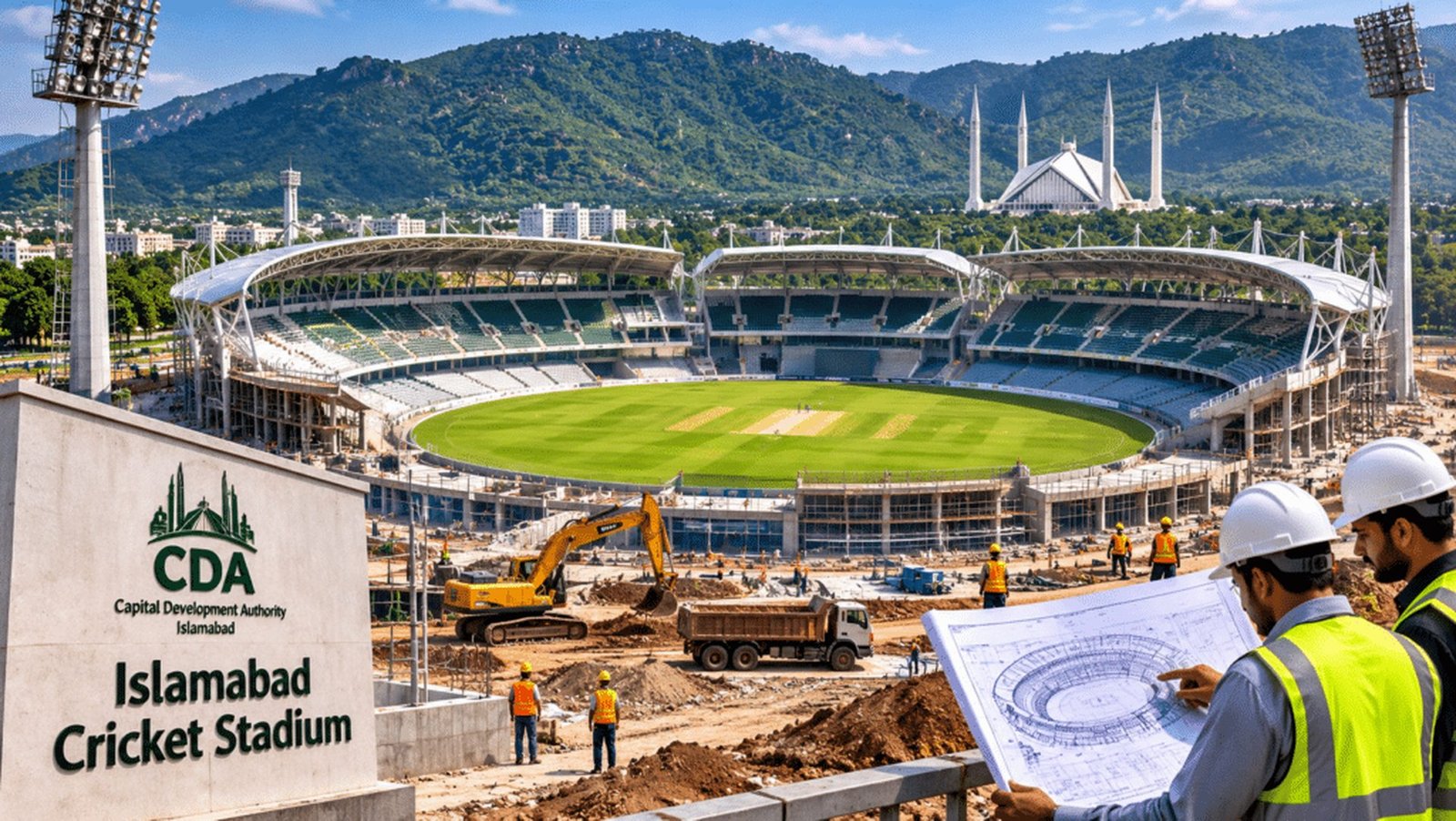
    The Capital Development Authority (CDA) has finalised a revised PC-1 for the Islamabad cricket stadium, under which the project’s total cost has risen from Rs11.9 billion to Rs16.7 billion, according to reports citing a senior CDA officer.

    The revised PC-1 for both phases of the project has been completed and will soon be placed before the CDA Development Working Party (DWP) for final approval, the reports said.

    The original, unapproved PC-1 had put the cost of the project at Rs11.9 billion. The increase follows the addition of new and modern features to the stadium plan, including the grey structure and finishing work, modern lighting, heating, ventilation and air-conditioning (HVAC) systems, the preparation of international-standard grounds and pitches, and a modern security camera system.

    Pakistan’s largest stadium

    The stadium was initially planned with a capacity of 25,000 spectators, but the capacity was raised to 35,000 after proposals were invited earlier this year. Once completed, it will be the largest cricket stadium in Pakistan.

    The stadium is to be built near Sector D-12, at the foothills of the Margalla Hills, and is modelled on the Dubai Cricket Stadium. The CDA has already completed the approach road from Margalla Road to the site, and the construction work is expected to begin shortly.

    Federal Interior Minister Mohsin Naqvi recently said at a press conference that the stadium’s foundation stone would be laid within 10 days. Officials have said the first phase of the project is likely to be completed within one year of work starting.

    The CDA had earlier received a bid of Rs8.9 billion from the Habib-ZKB-EA joint venture for the construction work, against the original PC-1 estimate of Rs11.9 billion. The revised estimate will now go through the DWP approval process before construction can proceed on the updated plan.

    The Pakistan Cricket Board hopes the stadium will be ready in time to host matches of the ICC Women’s T20 World Cup 2028, although that remains a target rather than a confirmed opening deadline.

  • Islamabad to Become Pakistan’s First Cashless City by Dec 31

    Islamabad to Become Pakistan’s First Cashless City by Dec 31

    The government has decided to make Islamabad Pakistan’s first fully cashless city, setting a final deadline of December 31, 2026, to bring all merchants and business centres in the federal capital into the digital payment system.

    A meeting on implementing the Cashless Islamabad project was held under the chairmanship of Minister of State for Interior Talal Chaudhry, attended by the chairman of the Capital Development Authority (CDA), representatives of the banking sector and senior government officials, Geo News and Pakistan Point reported on Friday. The banking sector representatives assured the meeting of their full cooperation for the success of the project.

    Chaudhry said that after November 30, no department of the Islamabad Capital Territory (ICT) administration or the CDA would accept cash payments from citizens or applicants, and all official transactions would be conducted through digital payment channels. The second phase aims to bring all small and large businesses in the federal capital into the cashless system by December 31, with digital payment facilities made available from street vendors to major commercial centres.

    He said 26,000 merchants in Islamabad had already been connected to the digital payment system. He added that the cashless system would improve financial transparency, tax monitoring and the overall transaction system, and that consultation and suggestions from all stakeholders were important for the project’s success.

    According to Chaudhry, Interior Minister Mohsin Naqvi had promised the prime minister that Islamabad would become Pakistan’s first cashless city. The government aims to make it the world’s first cashless capital, with no cash payments being received in any government department and all traders brought into a cashless system, he said. Work on the initiative was progressing rapidly on the special instructions of the prime minister and the interior minister, he added.

    The cashless push builds on steps already taken in the capital. The Islamabad district administration introduced QR code payments for fines earlier this week, making all assistant commissioners’ offices cashless, and the facility has also been implemented across the Deputy Commissioner Complex. The H-9 weekly bazaar became Pakistan’s first fully cashless market, and Islamabad International Airport has already transitioned to a fully cashless environment, becoming the first airport in the country to eliminate physical currency across its premises.

    Officials say the initiative is part of wider efforts to promote digital payments, modernise public services and make official payments more transparent. The CDA has already fast-tracked the expansion of QR-based payment systems across the city, with the cashless system functioning in weekly bazaars, the CDA’s One-Window Facilitation Centre and the metro and electric bus services. The government says the aim is for no citizen in Islamabad to need to carry cash, with all transactions facilitated through digital means.

    The deadline gives the administration and traders about seven weeks to complete the transition. The meeting decided that the project would be implemented in phases, with government departments going cashless first, followed by the city’s markets, shopping centres, hospitals, hotels, restaurants and other commercial areas.

  • CDA Gives Fazl’s Seminaries 15 Days to Submit Building Maps

    CDA Gives Fazl’s Seminaries 15 Days to Submit Building Maps

    Islamabad’s Capital Development Authority (CDA) has issued notices to religious seminaries linked to Jamiat Ulema-e-Islam-Fazl (JUI-F) chief Maulana Fazlur Rehman over alleged violations of building rules in the federal capital, 24NewsHD reported on Saturday.

    The notices warn that failure to comply could lead to legal action, including the sealing of the buildings, according to the report.

    One notice was served on Madrassa Akhtarul Uloom, which the authority says raised structures without getting their maps approved. The seminary’s administration has been directed to submit approved maps of the buildings within 15 days.

    The CDA’s action is part of its enforcement of building control regulations in Islamabad, under which construction without an approved plan and building on mandatory setbacks are treated as violations. Notices in such cases typically warn of sealing or demolition if the administration does not comply within the given deadline.

    Separately, the Securities and Exchange Commission of Pakistan (SECP) has issued show-cause notices to three Hajj operator companies linked to Mufti Ibrar, a close aide of the JUI-F chief, 24News reported on Friday.

    The three companies named are Sajjad Travels and Tours, AL Rehab International and Shukar Al Faizan Travels. The regulator has ordered AL Rehab International to hand over complete details of its beneficial owners, while the other two operators must formally explain their failure to comply with corporate transparency laws within the next 14 days.

    SECP officials said the action was part of a broader string of financial and corporate investigations targeting individuals and networks within this political circle, according to the report.

    The notices come amid a wider anti-encroachment and building-regulation drive in the capital, in which the CDA has in recent weeks served similar compliance notices on properties found to have unauthorised structures. In a separate action last week, the authority served a 15-day notice over alleged building violations at the JUI-F chief’s residence in Islamabad’s G-6 sector, citing construction within building setbacks and a guard post and generator on CDA land, according to a report in Dawn.

    Minister of State for Interior Talal Chaudhry has described the notices as part of routine action being carried out under the anti-encroachment campaign across the capital, rather than action aimed at any individual. The CDA has said that where violations are not removed within the deadline, it can itself remove the structures and pursue sealing, demolition or cancellation of the plot allotment under the building control regulations.

  • JIT: Hafeez Shaikh alleged mastermind of Constitution One

    JIT: Hafeez Shaikh alleged mastermind of Constitution One

    The federal government has approved a joint investigation team (JIT) report into alleged fraud and irregularities in Islamabad’s One Constitution Avenue project, naming businessman Abdul Hafeez Shaikh as the alleged mastermind behind the scandal.

    Planning Minister Ahsan Iqbal told a joint press conference on Wednesday that the federal cabinet had approved the JIT report, which found the project had been executed through manipulation of the bidding process, unauthorised relaxation of rules and suspicious documentation. He said Shaikh had been identified as the alleged mastermind, along with several former Capital Development Authority (CDA) officials and other individuals, including Kamran Lashari, Dr Faisal Awan, Azhar Ali Chaudhry, Brigadier Nusrat Ullah and the late Rai Nawaz Kharal.

    According to the report, 254 apartments in the project were sold through 99-year sub-leases even though the project had been approved as a hotel with serviced apartments. Iqbal said Shaikh’s company had been blacklisted from future public-sector projects, while Information Minister Attaullah Tarar confirmed that Shaikh’s name was on the Exit Control List.

    Interior Minister Mohsin Naqvi, who also oversees the CDA, announced that the One Constitution Avenue building would be converted into a five-star hotel within the next few months. He said the government would present the JIT’s findings to the public and ensure the recovery of any illegally occupied land without favour.

    The government has directed the National Accountability Bureau (NAB) to investigate the roles of those involved, with a reference to be filed against those found responsible within three months. Tarar said the NAB investigation would be conducted strictly on merit and completed on an expedited basis, followed by the trial process.

    Ministers also stressed that genuine buyers would be protected. The JIT recommended that the CDA compensate bona fide apartment buyers through refunds of their principal amounts, together with interest linked to the Karachi Interbank Offered Rate or an inflation adjustment, noting that the authority had collected fees before disclaiming responsibility.

    The controversy dates back to the mid-2000s, when the CDA auctioned the land for about Rs4.8 billion for a five-star hotel. The developer later failed to meet its financial obligations, and in 2019 the Supreme Court ordered payment of Rs17.5 billion in instalments over eight years, of which only about Rs2.9 billion had been deposited, according to reports earlier this year.

  • One Constitution victims paid in 2 days, hotel plan set

    One Constitution victims paid in 2 days, hotel plan set

    Victims of One Constitution Avenue in Islamabad will receive their compensation claims within two days, Federal Minister for Planning Ahsan Iqbal has said, as the government moved on two fronts over the troubled building: relief for those affected, and a new future for the structure itself.

    Iqbal said the federal government would ensure compensation for the victims, and that a committee formed by the federal cabinet had taken up the matter. He said he would supervise the committee himself, with the chairman of the Capital Development Authority providing a survey of the affected people so that payments can be made swiftly.

    He also announced action against officials held responsible. Three officers have been dismissed and nine suspended, Iqbal said, while a criminal case has been referred to the Federal Investigation Agency, with an investigation now under way. The steps signal that the government intends to pair compensation with accountability.

    Separately, Interior Minister Mohsin Naqvi visited One Constitution Avenue and chaired a meeting at the Capital Development Authority, where he announced that the building would be converted into a five-star hotel. He directed the CDA chairman, Muhammad Ali Randhawa, to remove obstacles to the conversion and to submit a plan for the project.

    During the visit, the CDA chairman briefed the meeting on progress so far. Naqvi also raised compensation for flat owners during the meeting, underlining that the residents caught up in the building’s troubles remain at the centre of the government’s response.

    The two announcements, from two different ministers and forums, address different sides of the same long-running matter. Iqbal’s statement focuses on the victims, the committee, the two-day payment pledge and the disciplinary and criminal proceedings. Naqvi’s visit focuses on what happens to the building next, with the hotel conversion presented as a way to put the site to new use.

    For the affected flat owners, the immediate question is whether the two-day pledge is met in practice. The committee’s survey of affected people will be central to that, since payments can only be processed once the list of claimants is settled. Residents and observers will be watching the coming days closely for evidence that the money is reaching those entitled to it.

    The hotel plan, meanwhile, raises its own questions about timelines, financing and the legal steps still required before conversion work can begin. Naqvi’s direction to the CDA chairman to prepare a plan suggests those details are still to be worked out, even as the headline decision has now been announced.

    Together, the announcements mark a significant moment for a building that has been a source of dispute and distress for its residents. Compensation within days, action against officials, a criminal investigation and a new plan for the site all point to an effort to close one chapter and open another, though the test will lie in delivery rather than declaration.

  • CDA gives JUI-F aide 15 days to clear encroachments

    CDA gives JUI-F aide 15 days to clear encroachments

    The Capital Development Authority (CDA) has given a 15-day deadline to Amanullah, described as a close aide of Jamiat Ulema-e-Islam-Fazl (JUI-F) chief Maulana Fazlur Rehman, to remove encroachments outside his residence in Islamabad.

    The encroachments are outside a residence in the G-6/4 sector of the capital. The CDA’s latest notice gives Amanullah 15 days to clear them, according to reports of the authority’s action on Wednesday.

    The matter is not a new one. The CDA had previously directed him on 18 March 2019 to remove the encroachments, the reports say, which means the issue has been outstanding for more than seven years before the latest deadline was set.

    Encroachments outside homes and on public land are a long-running problem in Islamabad, where the civic authority is responsible for keeping streets, footpaths and public spaces clear. Residents and civic bodies frequently disagree over where private use of space ends and public land begins, and enforcement drives tend to follow complaints or surveys by the authority.

    The CDA is the civic body that administers the federal capital, and it has the power to issue notices and take action against unauthorised structures and occupation of public land. In this case, the reports do not state what action the authority will take if the encroachments are not removed within the 15-day period, and this report does not speculate about any such step.

    The involvement of a person described as close to a senior political leader gives the case a political dimension, but the notice itself is presented as a civic enforcement matter concerning encroachments at a specific property. The reports do not quote Amanullah or the CDA directly.

    Whether the deadline leads to the encroachments being cleared voluntarily will become clear over the next two weeks. If they are removed, the long-standing file on this property can be closed. If they are not, the next move will rest with the CDA, which will have to decide how to enforce its own notice.

    For residents of the sector, the outcome matters in practical terms: encroachments on streets and public spaces affect access, parking and the general condition of a neighbourhood. Civic enforcement, when it is applied consistently, is one of the ways a city authority keeps those shared spaces usable for everyone.

    The CDA regularly issues such notices across Islamabad as part of its anti-encroachment work. This latest deadline is one more example of that continuing effort, and its progress will be watched to see whether a file open since 2019 is finally resolved.

  • Naqvi inspects Kashmir underpass built in record 27 days

    Naqvi inspects Kashmir underpass built in record 27 days

    Federal Interior Minister Syed Mohsin Naqvi has visited the site of the Kashmir Underpass project at Kashmir Chowk in Islamabad, where he reviewed the construction work under way and inspected the progress made so far. The visit, reported on 4 November, came as the project reached its final stage, with the underpass ready to be opened to traffic.

    During the visit, the minister was accompanied by Capital Development Authority Chairman Muhammad Ali Randhawa, the chief commissioner of Islamabad and other officials. Together, they went over the work completed at the site and looked at what still remained to be done before the underpass could be brought into regular use.

    Naqvi directed the project team to complete the remaining work at the earliest. His message was clear: with the main construction finished, no time should be lost in carrying out the final tasks so that the underpass can open without further delay. The instruction reflects the pace at which the project has been pursued from the outset, and the attention now being paid to its completion.

    According to the report, the underpass was completed in a record 27 days. That short construction period is the standout feature of the project, setting it apart from infrastructure works that often take far longer to finish. The speed of the work has been presented as a key achievement, and the minister’s visit served as a final check on a project delivered within that unusually tight timeframe.

    The underpass was expected to open to traffic the following day, on 5 November. For people who travel through Kashmir Chowk, the opening marks the point at which the project moves from a construction site to a working part of the city’s road network. The final inspection therefore carried real practical importance, as any outstanding work had to be identified and finished before vehicles began using the route.

    Visits of this kind are a familiar part of how major city projects are completed, with senior officials reviewing progress on the ground rather than relying only on written updates. In this case, the presence of the CDA chairman and the chief commissioner alongside the minister underlined that the project involved more than one part of the city’s administration, and that its final stage was being watched at the highest level.

    The minister’s direction to finish the remaining work at the earliest leaves little doubt about the priority attached to the project. With the underpass built in 27 days and its opening expected the next day, the focus now shifts from construction to completion, and from completion to the day-to-day use of a new underpass at one of Islamabad’s well-known junctions.