Tag: Austria

  • Austrian Ambassador Meets Sindh Assembly Speaker

    Austrian Ambassador Meets Sindh Assembly Speaker

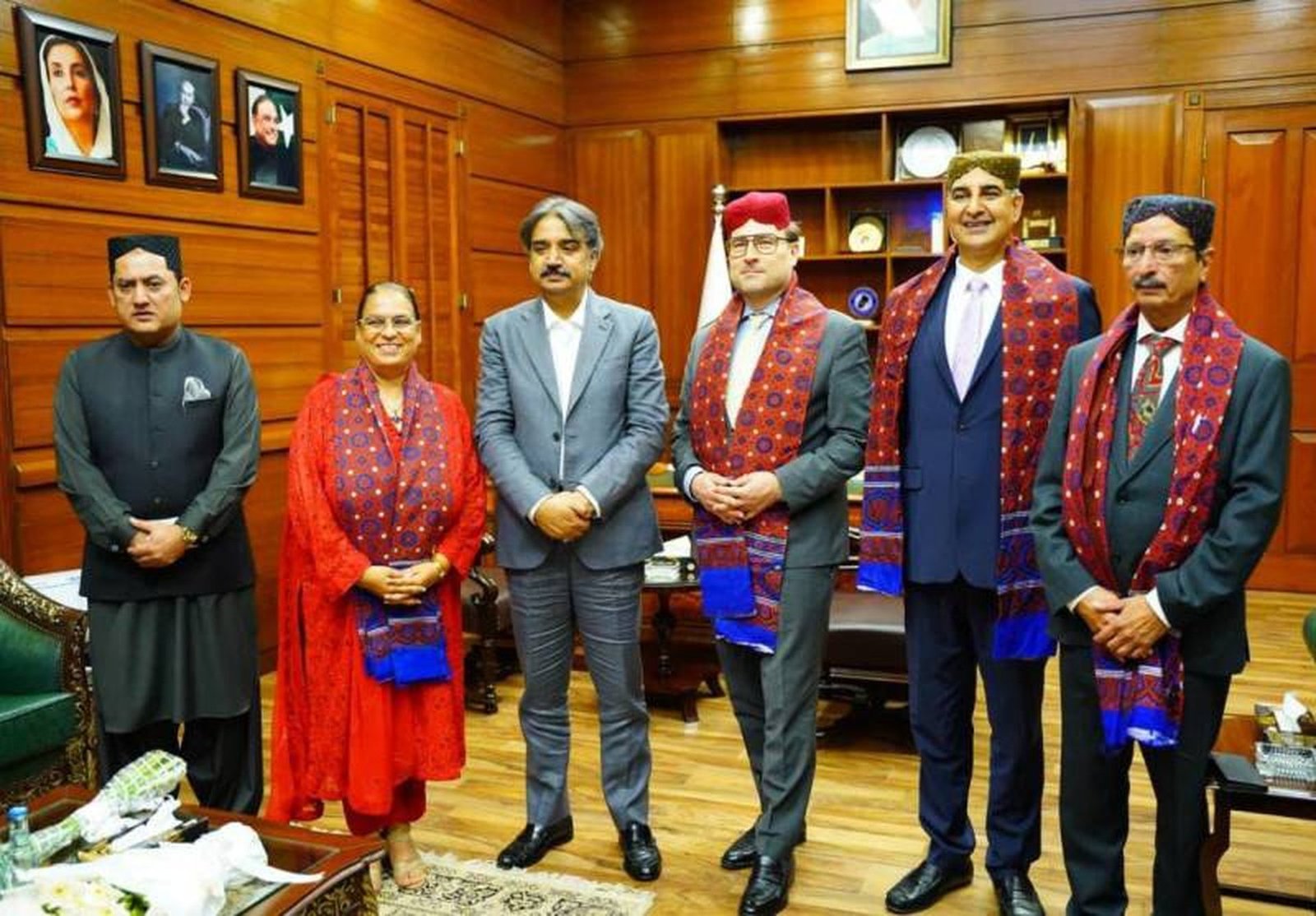
    The Ambassador of Austria to Pakistan, Wolfgang Oliver Kutschera, called on the Speaker of the Provincial Assembly of Sindh, Syed Awais Qadir Shah, at the Sindh Assembly in Karachi on 18 November 2026, 24NewsHD reported.

    The meeting focused on bilateral relations between Pakistan and Austria, parliamentary cooperation, cultural exchange, economic ties and the promotion of religious freedom and interfaith harmony.

    The ambassador was accompanied by Dr Hussain Islam, Honorary Consul of Austria in Karachi, Tushnamaity Patel and Cyrus Feroz Kanga, while Director General Media Irfan Ahmed Memon accompanied the Speaker.

    Both sides recalled their previous interaction at last year’s Austrian National Day celebrations. They appreciated the participation of Austrian artists in the ongoing World Culture Festival and commended the efforts of the Government of Sindh and the Arts Council of Pakistan for providing a platform for international cultural exchange.

    The ambassador emphasised the importance of strengthening people-to-people contacts. Referring to the existing Joint Committee on Economic Cooperation, he said the forum could help promote bilateral economic relations and facilitate Austrian companies in exploring investment opportunities in Pakistan.

    The Speaker invited the ambassador to visit different cities of Sindh, particularly Sukkur, and briefed him on the city’s historical and cultural significance, heritage sites and places of tourist interest. The ambassador expressed interest in visiting Mohenjo-daro, historical landmarks and the shrines of Sufi saints across the province.

    Assembly’s history and legislation

    Highlighting the historical significance of the Provincial Assembly of Sindh, the Speaker told the ambassador that the Assembly had passed the historic resolution in favour of a separate homeland for the Muslims of the subcontinent in 1943. He also recalled that Quaid-e-Azam Muhammad Ali Jinnah addressed the Assembly after the creation of Pakistan and that the national flag was hoisted there.

    The meeting also discussed legislative matters, including the Christian Marriage Law. The Speaker said considerable progress had been made and that Deputy Speaker Anthony Naveed was actively working on the matter. He expressed hope that the legislation would be passed through consensus and consultation with all stakeholders, including religious leaders, political parties and civil society.

    Exchanging views on religious freedom and interfaith harmony, the Speaker said religious minorities were an integral part of Pakistan and equal citizens. He said religious harmony, religious freedom guaranteed under the Constitution and the protection of equal rights for minorities remained among Sindh’s key priorities, adding that the PPP-led provincial government was committed to promoting an inclusive society where all citizens enjoyed equal rights and opportunities.

    Parliamentary cooperation

    The Speaker also recalled his visit to Vienna and the Austrian Parliament, appreciating its institutional arrangements, and referred to a Pakistani delegation’s training visit on the establishment and functioning of a Parliamentary Budget Office, stressing the value of international experience in strengthening parliamentary institutions.

    The possibility of establishing a Parliamentary Friendship Group between the Provincial Assembly of Sindh and the Austrian Parliament was also discussed, as a forum that could facilitate delegation exchanges, legislative cooperation, institutional capacity building and stronger people-to-people contacts. Highlighting provincial autonomy after the 18th Constitutional Amendment, the Speaker said devolution had given provincial assemblies greater opportunities to legislate according to their needs and to establish direct relations with parliaments around the world. Both sides expressed their commitment to further strengthening Pakistan-Austria relations.
  • Austrian Ambassador Visits Arts Council Karachi, Enjoys Leva Dance at World Culture Festival

    Austrian Ambassador Visits Arts Council Karachi, Enjoys Leva Dance at World Culture Festival

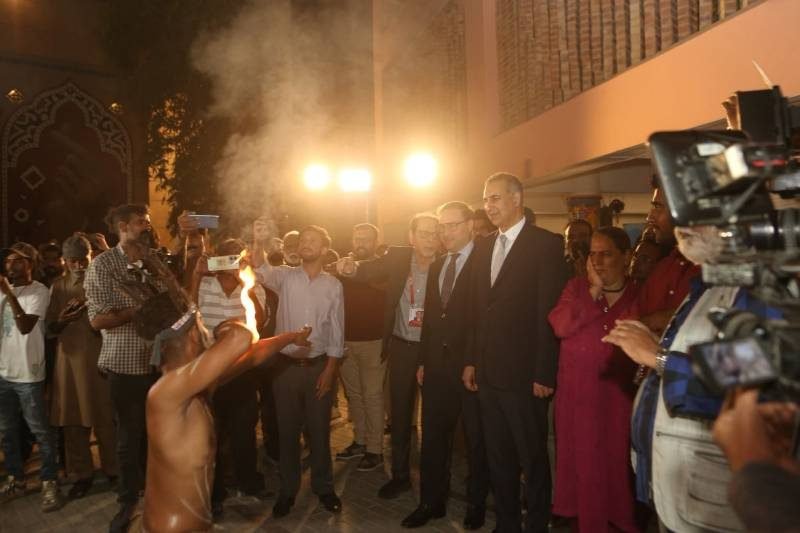
    Austrian Ambassador to Pakistan Wolfgang Oliver Kutschera visited the Arts Council of Pakistan Karachi during the ongoing 3rd World Culture Festival 2026, 24NewsHD reported on Wednesday, November 18, 2026.

    During the visit, the ambassador explored various cultural activities and performances at the festival and particularly enjoyed the traditional Leva dance performance. The vibrant performance captivated the audience, with local citizens enthusiastically joining in the dance, creating an atmosphere of cultural celebration.

    The Austrian ambassador also met with President of the Arts Council Muhammad Ahmed Shah. During the meeting, discussions focused on promoting cultural ties between Pakistan and Austria, enhancing cooperation in the field of arts, and exploring opportunities for cultural exchanges between artists of both countries.

    Kutschera appreciated the initiative and described the World Culture Festival as a welcome platform for bringing different cultures together, promoting artistic collaboration, and strengthening people-to-people connections. The visit highlighted the importance of cultural diplomacy in fostering friendship, mutual understanding, and stronger relations between Pakistan and Austria.

  • Infineon Invests €1.1bn in Austria Chip Plant

    Infineon Invests €1.1bn in Austria Chip Plant

    German semiconductor manufacturer Infineon has announced an investment of €1.1 billion, about $1.23 billion, in its Austrian site to expand production of power semiconductors used in data centres, the company said on Tuesday.

    The project will be based in Villach, Austria, where Infineon plans to build what it describes as the world’s first plant for the mass production of gallium nitride semiconductors on wafers measuring 300 millimetres in diameter. Gallium nitride, often shortened to GaN, is a material increasingly used in power electronics because it can handle high voltages and operate efficiently in compact devices.

    According to the company, wafers of 300 millimetres can hold 2.3 times as many chips as the 200-millimetre wafers most commonly used today. That difference matters for manufacturing economics: larger wafers allow more chips to be produced from each wafer, which can bring down the cost per chip and increase output from the same production line.

    Infineon said the new capacity would support a wide range of applications, including artificial intelligence, energy infrastructure, electric mobility and robotics. Those fields share a common demand for power semiconductors that can convert and control electricity efficiently, whether in a data centre server, an electric vehicle charging system or an industrial robot.

    Data centres are a particular focus of the investment. As artificial intelligence workloads grow, data centres require ever more electricity, and the efficiency of their power systems has become a central concern for operators and for energy grids. Power semiconductors sit at the heart of that system, managing the flow of electricity to processors and other equipment while limiting energy losses as heat.

    Chief executive Jochen Hanebeck said in a statement that the project would pave the way for the wider use of gallium nitride across key applications. The company presents the Villach plant as a step from specialised production towards large-scale manufacturing of the material.

    The announcement comes at a challenging time for Infineon’s share price, which has fallen by around 40 per cent since the middle of June, according to Reuters. The shares rose by nearly one per cent in early trading in Frankfurt on Tuesday following the announcement.

    For Austria, the investment reinforces Villach’s role as an important European semiconductor location. Chip manufacturing in Europe has become a strategic priority in recent years, as governments and companies have sought to strengthen regional supply chains and reduce dependence on production elsewhere in the world.

    The move also reflects a broader shift in the semiconductor industry towards materials beyond traditional silicon. While silicon remains dominant, materials such as gallium nitride are gaining ground in applications where efficiency, size and power handling are decisive factors.

    If the Villach plant delivers mass production at the scale Infineon envisages, it could help bring gallium nitride components into wider use, lowering costs and supporting the expansion of data centres, electric transport and automated industry across Europe and beyond.